Thursday, October 8, 2020

Meet the Ancestors!

 Meet the Ancestors was one of my favorite British TV shows a few years back, although they were researching folks as old as Stonehenge! One of my favorite pictures is an old family photograph in my Mom’s cedar chest. It is three generations of my Stucker ancestors. My great grandfather is the tallest boy on the right (Charles McCollum), his mother, my great great grandmother (Clara Stucker McCollum Asa) and my great, great, great grandfather ( the older gentleman seated, Thomas Reuben Stucker). This photograph was taken circa 1899. My great great grandmother had been widowed the year before with three small sons. She remarried the fellow seated to the right of her father (R. J. Asa). 

Times were very hard for these southeast Missouri pioneers. As you can see, they are standing in front of a cypress board shack in Canalou, Mo. Just about all of the children are barefoot. My mother remembers the house burning down one very hot, Fourth of July day. She said Ma was canning jelly and the house burned to the ground. They managed to save 2 trunks of family heirlooms. Can you imagine? Canning jelly on the hottest day of the year, WITH A WOOD STOVE in hot, humid southeast Missouri! They stood and watched their whole livelihood burn in a matter of minutes. My Mom remembers seeing old family photographs be licked up with flames while they hung on the wall. What heirlooms were lost? Probably my great, great, great grandfather’s civil war memorabilia. He joined at age 15 and went through the whole thing without a scratch. He was said to be “meaner than a dog”. I guess so, no telling the horrors he witnessed. Post traumatic Stress Disorder was not given a name until over 100 years later during Vietnam Nam. 

Their legacy goes back even further. The Stucker family emigrated from Germany at the dawn of the French and Indian war (1750’s). They settled in Berks county Pennsylvania. Their next door neighbors happened to be the family of Daniel Boone. My 5 times great grandfather (George Stucker) and Boone were friends. Everywhere Boone went, my family followed. They followed him to Kentucky during the American Revolution. My 5 times great grandfather and his son (also named George) joined the militia as was pretty much required of all able bodied men. In 1781, a British General named Byrd had his Shawnee Indian allies attack Boone’s little forts all along the Kentucky frontier. Both my 5 times great grandfather and his son were killed.  Everyone left alive fled to the next fort (or station as they were called) Bryant’s station, which was Boone’s in laws. The Indians followed and laid seige  to the little fort.  The settler’s only water source was a spring outside the stockade. The women and children volunteered to get water, knowing the enemy was just outside that gate. The Indians left the women and children alone, wanting to lure out the men. My 5 times great grandmother was one of those women. She volunteered even after just losing her husband and son to the enemy just outside that gate. 

I can’t comprehend the bravery, stamina and just sheer guts it took to survive those hard times. We have it so easy today. Water and food at our fingertips. Our every want and desire within easy reach. I pray I can live up to the standard they set so long ago!


Tuesday, January 28, 2020

Manners.....what a concept?  It seems like something we used to take for granted, something everyone seemed to have ingrained into our early years from the time we could speak.  "Don't forget to say please and thank you" we would say to our children and also heard from our own parents.  What prompted this dialogue on manners you say?  Well, I'll tell you a story that happened to me today and I just can't ignore it.
I was running errands in town this morning and stopped by my favorite store: Barnes and Noble.  If you know me, you know I LOVE BOOKS!  While browsing the shelves and relaxing and enjoying myself, a woman passed right in front of me and the bookshelf.  Slowly, sauntering her way into my line of vision, I was appalled.  Excuse me? EXCUSE ME!!!!! I wanted to shout.  How rude!  And then I thought, does no one have manners any more?  Not even the most basic of manners?  Evidently they are getting fewer and far between.  But then I thought, "have I done something similar before?"  I would like to say absolutely not, but probably I have.  Not as rude as what happened to me today because I try to say excuse me constantly in a public area, even when it's not my fault.  But I have probably been guilty of some faux pas in the manners department.
Reading through the above little books, I am reminded how big a part manners played in early America.  George Washington memorized those 110 rules of civility while he was 15 years old.  No wonder he was considered the very image of gentlemanly behaviour.  Some are out of use and quite comical, such as #13: "Kill no vermin as fleas, lice, ticks &c in the sight of others.  If you see any filth or thick spittle, put your foot dexteriously upon it. If it be upon the clothes of your companion,  Put it off privately, and if it be on your own clothes, return thanks to him who puts it off."  Now I know we don't have to pick vermin from each other, but the point is be aware of how you look and help a companion if necessary.  Glad he never went to Wal-Mart!  But my very favorite rules are the first and the last that he memorized: #1"Every action done in company ought to be with some sign of  respect to those that are present" and #110 "Labour to keep alive in your breast that little spark of Celestial fire called Conscience".  Remember Jiminy Cricket? "Always let your conscience be your guide".  
Our Heavenly Father put this little "Celestial Spark" in every one of us.  If we would all strive to at least follow these two rules every day, what a better place this would be.  These two rules remind me of the life that Jesus Christ exemplified for us every day and are what he calls the two greatest commandments:  Love the Lord your God with all your heart and Love your neighbor as yourself.  Who is our neighbor?  In this day and age, it is not those who are just like us, believe just like us, look like us, or affiliated with our political party, but anyone we come into contact with.
My goal for 2020 is to try to obey those two commandments with all my heart and those two rules in George Washington's little book.  Love and respect will go a long way and it begins with me!

Monday, January 20, 2020

The Brooks house: 
This is as much as I know about the Brooks house so far.  It was built in 1850 by a free black man named Etienne Cashmere.  Like so many of the folks in Ste. Genevieve at the time, Mr. Cashmere was of mixed race (French and African American).  I’m Missing the history from 1850-1890 
so that’s where we’ll pick it up.  Mr. Bill Brooks was born around 1893 in Ste. Genevieve, Mo.  He was at the right age to serve his country during WW I (The Great War).  His unit was in combat in France which was highly unusual for that time.  Colored troops were usually relegated to the service areas of the military, such as cooks, etc.  Mr. Brook’s unit saw heavy combat and he came home highly decorated.  He married a young lady named Johanna McNabb and they had three sons.  Mrs Brooks was very well educated and was a college professor at Harris-Stowe University in St. Louis, Mo.  She also taught the black children of Ste. Genevieve in this house and at the little black school on the other end of town.  She decided to go to nursing school in St. Louis and was tragically killed in a car accident on her way home one night.  Mr. Brooks never remarried and was left with three small sons to raise on his own.  They were aged six, four and two at the time of her death.  Education was very important to the Brooks family, but they could only attend school to the eighth grade in St. Genevieve due to segregation.  When it was time to go to high school, Mr. Brooks put the boys on a Greyhound bus every morning and sent them to Festus, Mo., 35 miles north of Ste. Genevieve where they attended the black high school. Wanting to achieve more, they all entered the military to get college educations through the GI bill.  The oldest son, Bill Jr. became the Vice President of GM in Detroit and was also appointed as Assistant Secretary of Labor under President George H.W. Bush.  The middle son Sydney was great at Football and went to USC where he mentored a young player named O.J.Simpson.  O.J. named his first born daughter “Sydney Brook” after his mentor.  Youngest son Jack joined the Air Force and worked at the Pentagon for a time before returning to St. Louis to work for McDonnell Douglas.  The neatest thing is my small connection to this wonderful family.  I went to a small, private school in Festus and we needed a gym facility for our sports programs.  My school bought the old high school for colored students and I was watching games and doing high school plays in the same building these boys attended school. So I call the Brooks lHouse my “miracle” and I am so honored to have played a small part in saving this historic home.

Thursday, July 4, 2019

Hannah Davis Boxes

“A place for everything and everything in its place”
If you lived in earlier times in America, closets were a rarity.  If you think the IRS is a pain now, early Americans were taxed on closets! Anything with a door in a wall was considered a room, rooms were taxed as part of the house. No wonder folks had so many cupboards, chests, boxes, etc. Clothes were stored in a linen press, blankets and quilts in a blanket chest, sugar in a sugar chest (with a lock!), pies in a pie safe- you get the picture!
Back in 1784 a baby girl was born in Jaffrey, New Hampshire. Her name was Hannah Davis and she didn’t have a very easy life.  By the age of 34, she was unmarried and both parents were passed away.   Who would support her? She quickly realized she would have to depend on herself. Possessing that wonderful trait called “yankee ingenuity” she started making wonderful boxes from strips of green pine wood.  She even invented a foot powered slicing machine to cut the strips of wood faster. She used wallpaper scraps for the outside and lined the inside with newspaper gathered from neighbors and friends. With all the hats, collars, gloves and miscellaneous accessories people used, her business grew. She decided it was time to go on the road with her boxes. She loaded up a wagon with various sizes of boxes and headed to the cotton mills of Massachusetts along the Merrimack river. Young female mill workers scarfed them up, putting as one source quoted, “all their worldly goods” inside. They would make a drawstring bag for their box and carry it like a purse. 
 My rendition of Hannah Davis’s boxes are made in the same way, only I use heavy chipboard instead of wood. They are hand sewn and this little group is made with reproduction antique papers and lined on the inside with copies of colonial newspapers. A genuine Hannah Davis box will set you back thousands of dollars while mine are only $28.00 each! Maybe some day mine will be valuable heirlooms as well. I am proud that these boxes have earned me a position in Early American Life Magazines’ Directory of top traditional American craftsmen!

Thursday, June 20, 2019

The History of Floor Cloths

Floor Cloth by Sassasfras Creek Originals

The history of floor cloths is fascinating to me, as is everything about how our
Colonial ancestors lived. They look complicated, but they are more time consuming than difficult. You can be as simple or elaborate as you want depending on your skill level.

Historians believe their history began as early as the Renaissance in France or Italy. They started as table coverings but leave it to those ingenious colonial Americans, they took it to the next level! Early Americans used old ships sails (“waste not, want not”) to paint designs with oil based paints to produce a cloth that was large enough to cover whole rooms of their houses.  Hence the name “oyl cloth”). They were easy to clean, took muddy boots, children, pets, and any other daily wear and tear that could be thrown their way. They kept cold drafts from coming through cracks in your floor. They were cool to walk on barefoot in the summer time. And when they wore out, you could easily make another!

Floor Cloth by Sassafras Creek Originals

Today, it is easier than ever to make your own with the wonderful latex paints and tools we have available. I made mine from scratch with a large roll of cotton canvas from an art supply store.  I had to prime mine with a primer, but you can buy pre-primed canvas at Hobby Lobby. Buy some latex porch and floor paint, figure out your design and buy lots of frog tape! Start simple with maybe a checkerboard pattern or buy some stencils and stencil one. Stenciled floorcloths were especially popular in the early 19th century and were found in taverns and homes throughout New England. I buy all of my stencils from mbhistoricdecor.com. They have exact replicas of 18th and 19th century stencils.

There are all sorts of detailed web sites showing you how to make your own so get started! You’ll be amazed at what you can do! Make a small one and put it in front of the kitchen sink, or if you can’t fit a rug under your doors, put a floor cloth there. You’ll be walking in the footsteps of your ancestors!


I made this floor cloth about 20 years ago. They just get better with age!

Wednesday, February 27, 2019

Penny dolls


I never really was a doll lover as a child. I had a few Barbie dolls, but I always cut their hair off. I was a bit of a tomboy and would rather play cowboys and Indians outside, but occasionally, when the weather wasn’t great or I was sick, I would play with Barbie. I absolutely did not play with baby dolls! My Mom had her antique ones with cracked faces that were creepy.  They scared me and then my sons when they would spend the night with their grandparents. Two generations of scarred and scared kids! So why do I like dolls now I wonder? Well, not all dolls, but the sweet, simple homemade kind. I guess they would be considered historic dolls. My favorite is the penny doll. So called because they were inexpensive. Some are so tiny, they will fit inside a walnut shell! They were simple, wooden dolls and were sold undressed so little girls could learn to sew clothes. Some were made by hand by loving fathers or grandfathers, others were store bought. They remind me of the simpler time period I love so well. In 2016, I went to Colonial Williamsburg and there she was- all alone in a glass case, just waiting for me. She was on sale, but certainly not a penny! I decided to sleep on it and if she was still there the next day, she would be mine. Obviously, I found her the next day and brought her home with me. I still haven’t named her, although I think I will name her Abigail or Martha, after my favorite two First Ladies or maybe an old fashioned name like Patience to remind me of that virtue of which I am sorely lacking! Whatever her name, she is always smiling at me, always in a good mood and that makes me happy. I will try to be more like her!

Thursday, February 21, 2019

Putz Sheep


Good morning everyone!  Spring is just around the corner and I thought I would write about one of my favorite things for the season- Putz sheep!  I sell out of these little darlings at Christmas time but they are just as popular at Easter.  
At Christmas, they remind us of the lowly shepherds, keeping watch over their flocks while the baby Jesus was being born in Bethlehem.  At Easter, they remind us of the perfect Lamb of God who was slain for our sins.  
How about a little history lesson on these guys?  These traditions derived from my favorite group- the Moravians (German speaking protestant missionaries who came to America in the 18th century).  Families would construct a nativity scene at Christmas time and each year the scene would grow larger and more elaborate as you can see from the picture.  The central scene is of course the nativity with the Holy Family, wise men, shepherds, sheep and camels.  The village would grow around the nativity scene.  
There are several meanings for the word "Putz". In German, it can mean plaster, finery or adornment.  All of these words apply to a Putz village because most of them are rendered or decorated with fine, plaster figurines.  In the Jewish Yiddish, it means a fool or someone obnoxious, someone who is a "putz!".  Personally, I prefer the German derivation! 
Beautiful little houses and animals are rare and expensive finds if they were made in the Erzgebirge mountains of Germany (think of cuckoo clocks and the Black Forest region).  
The sheep pictured in the first picture are antique ones probably made before WWII.  Today, fine reproductions of those same sheep are for sale right here in my shop and much less expensive than the real things!

Thursday, January 24, 2019

Colonial Sugar Cones

Today, I thought I would make some colonial sugar cones and share the process with you all.  These are a great seller in the store with my line of early American teas and I was sold out so time to replenish! Supplies needed: 5lb. bag of sugar, a glass or object with a cone shaped inside, non stick spray, a blunt ended object for tamping (I used the one that came with my meat grinder and it’s perfect!), wax or parchment paper.  I begin by putting about 2 cups of sugar in a bowl and add approximately 2 Tbsp of water. Stir the sugar and water with a fork until it’s the consistency of wet sand. Put a small amount in the bottom of your glass and tamp down. Keep adding sugar and tamping til the glass is full and shave any excess from the top. Turn your glass over and gently but firmly slam it on the counter to unmold. I only sprayed my glass the one time and I got 6 cones from one bag of sugar.  They weigh 12 oz. each.


Leave them out to air dry for 2 or 3 days, depending on the humidity. Then wrap in blue paper and you’re done! This is a great way for homeschoolers to learn the history of processing sugar while they’re at it.  For prim lovers, this can also be done with brown sugar and wrap in tea stained cheesecloth.

Thursday, January 10, 2019

Let's Play A Game


Colonial games and cards were popular in New France as well as in the British colonies. . .The fun-loving French hunters and trappers spent many a day around tables such as this. . .smoking their clay pipes. . .drinking their wine. . .wagering money from the sale of their pelts. . .and often losing a pocketful of coins. . .No problem. . .There were plenty more animals to trap. . .C'est la vie. . .(That's Life)

Saturday, November 18, 2017

Turning a new page

OK folks, it's been over a year since I posted to my blog and I really don't have any excuse for this other than the fact that I really don't know what I'm doing with this technology stuff.  I am an artist and art and technology is for millennials, not old fogeys like me.  Anyway, I am going to try to do this on a regular basis since I am opening a new shop in Ste. Genevieve and I want to keep everyone up to date on the progress.  I feel like this is redundant since I put the same things on my facebook page but here it goes.  I close on the final paperwork for my store on Wednesday, Nov. 22.  Finally!  This has been in the working since late August.  I had no idea it would take this long so it's been a learning curve.  I would like to have a website for my new store with the ability for you all to purchase online but I have no idea how to do this without it costing a fortune.  I have tried several DIY sites only to stop about 1/4 of the way through because it's too complicated and they don't have a template for colonial enthusiasts like me!  Anyone out there with any suggestions, please help!

Monday, February 15, 2016

Mice In The House. . .


Just put these sweet little mice in my two booths (St. Mary's and Farmington's Forever Antiques).
They are completely handmade by me and have little folded sailor hats made from copies of vintage newspapers.  I have neglected my blogspot lately and I apologize.  I will try to get things going in the future.  I am working on some new hand-sewn band boxes covered with civil war era fabrics.  So keep an eye out for those in the antique mall.  I will also have some big news involving chocolate in the near future and I am so excited about it.  That's all I will say about it for now.  Hopefully in the next couple of weeks it will be ready.

Monday, June 15, 2015

What An Honor!

Here is a picture of my newest booth from the antique mall.  These are a few of my hand painted gameboards and a little of my artwork.  I will try to put more in asap.  My boards were also chosen for Early American Life's directory of craftsmen.  What an honor!

Monday, May 4, 2015

Handmade Toile Boxes


Here are two handmade boxes custom made for a very sweet customer in Wisconsin.  They are 16 and 15 inches in diameter and about 8 inches tall.  They are completely hand-sewn from top to bottom and the insides are lined with reproductions of the Virginia Gazette from 1776.  The outside is a beautiful reproduction colonial fabric and the inside and outside are gently aged.  Please call for pricing specifications if you wish to purchase a custom made box.

Thursday, February 19, 2015

18th century Horn Books

Here is a sweet little item I have wanted to make for years and never got around to until now.  This is called a Hornbook.  I know that sounds kind of funny but I'll give you a short history lesson.  Hornbooks were the first tool that children used in early America to learn their ABC's and vowels and they were invaluable for introducing a child to reading. They were first made of cow's horn that had been flattened by heat and had the paper with the lesson glued to it.  That's why they were called "horn"books.  They were in the shape of a paddle with a handle and string so the child could carry it around with them to learn.  Maybe there was only one available in the home and it was passed down from child to child.  The majority of our founding fathers and mothers used this little paddle at home.  Just think about it for a moment, very few people in the 18th century had formal schooling and were taught at home, yet some of the most brilliant and influential minds in the history of mankind started with just such a simple thing.  George Washington and Benjamin Franklin for example had no formal schooling whatsoever!  Thomas Jefferson and John Adams were mostly schooled at home or by itinerant tutors until they went to college.  Can you imagine getting into Harvard University today with just a home-school education?  John Adams did!  But what I think is the most important part of this little book is The Lord's Prayer at the bottom of the page.  In early America, it was just as important to know the precepts of God at an early age as it was to know your ABC's.  After all, the Bible was used in public schools in the beginning to teach children to read from.  What an important lesson we can learn from this simple little page.  Early Americans knew then what we have forgotten  today:  it says in Proverbs "The fear of the Lord is the beginning of all wisdom".  If you are afraid of the times we live in today, and want to know how we can fix America and deal with the problems of this world, we must return to our founding spiritual roots.  We must pray and ask God to forgive this country for leaving him out of our government, our schools, and our lives.  He says "If My people, who are called by My name, will humble themselves and pray and turn from their wicked ways, then I will hear from heaven and forgive their sin and heal their land!  May God bless America but most importantly, may America Bless God!

Sunday, April 13, 2014

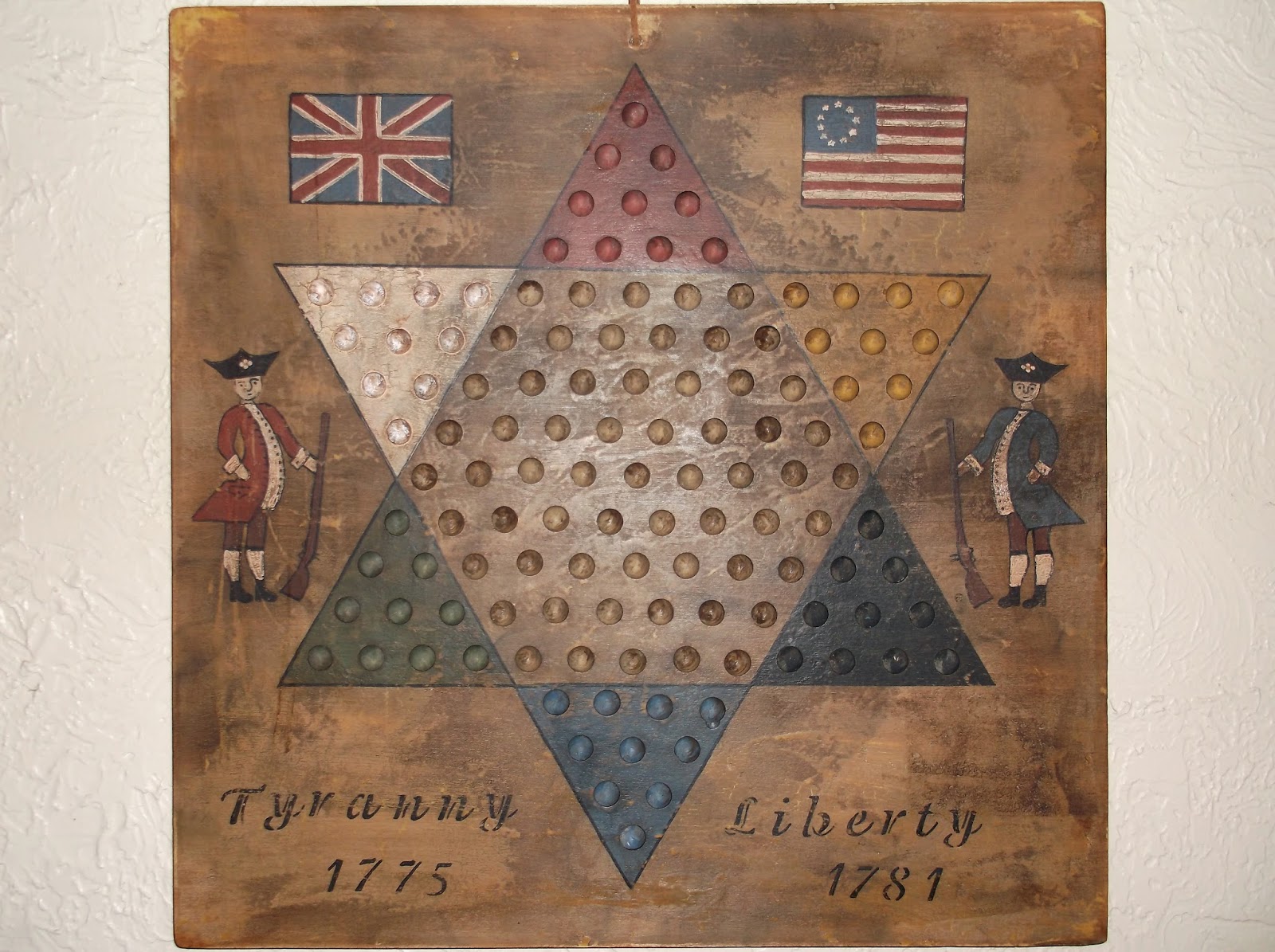
This is my newest Chinese Checkers design.  Given the atmosphere that seems to be pervading the country at this time, I thought I would make a checkerboard designed with our founding principles in mind.  Do we still have liberty or do we have tyranny?  You decide.  Let us not forget the valuable price that was paid for our freedom.  This board sells for $55.00 plus S&H and includes glass marbles.


Here are some new items I've added recently.  I decided to make some mini-notebooks like my large journals only they are just 4 1/2 inches by 3 inches.  Many of them have the same pictures as the larger journals and they come with a mini pencil.  They are 4.50 each plus S&H.  I also covered a few more antique books in vintage fabrics and have a feather or a charm attached.  They sell for $13.00 ea.  And last but not least, a couple of make-do pin cushions from some vintage fabrics on a candle stick.  They sell for $22.00 each.


I opened my second booth at St. Mary's Antique Mall on April 1, 2014.  I am so excited and it is right across the aisle from my first booth!  For those of you who don't know where St. Mary's is, it is about 8 or 9 miles south of Ste. Genevieve, Mo. on old Hwy 61.  Here are a few pictures.  I've added some different furniture pieces that are hand-made right here in Missouri.  Love the big old document box in the second picture.  The child's drop leaf table is an antique piece and so cute.


Thursday, February 27, 2014

Here are some of the new items I have just finished for the 2013 Christmas season.  These are journals I covered with papers I aged myself.  They are available in Washington, Jefferson or Lincoln and include a twig pencil.  They are $9.00 ea.

Sunday, February 16, 2014

Some new journals to add to my collection of men's journals.  I've added Young George Washington (he's not just some old dead dude on the dollar bill!), a beautiful Indian painting by George Catlin, Daniel Boone and Lewis & Clark.  I've also made some journals for the ladies covered in vintage fabrics with some of my favorite heroines: Martha Washington, Abigail Adams, Molly Pitcher, and some cute colonial folk art paintings of little girls.  I've added a white feather quill ink pen to go with the ladies journals.  They are also $9.00 ea. plus S&H.  Fabric colors may vary.